Mexico Lindo Y Querido . . .
January 12, 2008
 It has been well over one month since this blog has seen its author, but alas, I arrive with a treasure trove of tales of the land to the south. I spent my holiday in Mexico this year with my sister and my brother-in-law at his family's hometown that lays between Leon and Guanajuato in the state of Guanajuato in south central Mexico. My trip involved quite a bit of travel throughout southern Mexico, including Guadalajara, and the gold coast of Mexico along the southern Pacific (between Alcapulco and Puerto Vallarta). The trips by car and bus were rather long, but ultimately worth the adventure - however rugged it turned out to be (showers and toilets were not always available).
Because this blog is devoted to food, I will share my experience through food goggles. To begin, I arrived near midnight in the city of Guadalajara. I had not eaten all day and was near death when I got to my hotel. I immediately took my nephew and grabbed a cab to the only restaurant in the vicinity that was not closed already, and ended up at "Sanborn's" - a strange mix of 24 hour diner, candy shop, and book seller. The coffee was terrible, and the frijoles refritos were clearly left out of the fridge overnight -- it was like having a meal at the Breakfast King. I ordered the tri-colored enchiladas with sweet mole, ranchera chile (made from tomatoes) and a tomatillo chile verde--the only edible thing on the plate and rather delicious. My nephew stuck to his diet of meat, meat, and more meat. His "vegetable" side consisted of a basket of warm corn tortillas. While the china was charming, the quality of this diner food left much to be desired -- but much better than airport food. I think next time I will just wander the street for a taco truck.
One thing I do regret, however, about my trip to Sanborn's was that I did not load up on that terrible coffee while I had the chance - I was horrified to be scolded over and over by my many mothers and sisters in Mexico about the destructive nature of coffee, that I will be afflicted with the shakes, and that I will eventually shrink (as if this is not already the state of things). I was stuck with instant coffees and thinned syrup at local convenience stores as an alternative. Fortunate for me, I packed a 1/2 pound of my own coffee grounds - but finding an automatic drip machine was quote another challenge . . . if I had to do it again, I would pack my Nalgene Press-Bot Coffee Press.

After being rescued from Guadalajara, I was driven to Leon, but had the fortune to stop at Mariscos de Luis that lay just about 20 minutes out of the city and off the side of the highway along a dirt road. This seafood fonda was an open-aired shelter filled with tables and chairs, and plenty of Pacifico. The food was outstanding. I was brought a small plastic cup filled with a piping hot seafood broth and whole shrimp - head and all. It was like eating a rich ciopino. I ordered shrimp tacos, but I think the best thing I ate was a shrimp cocktail filled with stewed tomatoes, avocados, onion, garlic, and chile. The surprise was that the dish was served warm with crackers -- yes, crackers (what happened to tostadas?!). This was perhaps the best meal I had during my whole trip.
Upon settling in at my sister's house, I was taken to her mother-in-law's house for preparation of the Christmas tamales. To begin, we had to prepare the masa (dough). Making masa takes
 hours, and in Mexico, it is all done from scratch, not from instant Maseca packages like we are accustomed to in the States. The corn was hulled, cleaned, and placed into buckets with water to soak overnight. At dawn, I left with Jova, my "concunada" (Sister of my brother-in-law) to the molinero (local corn grinder). We took about eight 5-gallon buckets to the grinder and promptly mixed in each bucket a whole bag of rice just before grinding. I was told that this would make the tamale more spongy.
The masa was then subjected to about 5 hours of kneading and resting by a group of women at Dona Nicha's house (my sister's mother-in-law). We made three fillings while the dough was prepared: pork and red chile, tomato-chile-cheese, and sweet tamales with spices and raisins. The whole process took until about four in the afternoon and then another 2 hours for proper steaming in large stock pots. The tamales were finally ready for eating and I ate about 9 of them before passing out from exhaustion and ultimately a food coma.
Well, this covers the first half of my trip, and I fear that anymore typing will make my tired eyes droop to sleep. So I leave you for now, with promises to type more about the second half of my trip to Manzanillo and neighboring beaches along the Pacific coastline.


Chico Soup with Red Chile
November 15, 2006
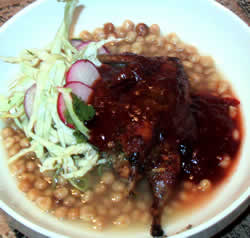
Having worked so hard this fall to prepare the chicos, I was pleased to make chico soup with a twist. While most chico soup recipes call for roasted beef ribs, pork, or chicken, I decided to use a traditional Mexican game bird instead: the humble quail.
This recipe has three main parts: chicos, quail, and red chile. I suggest you make the red chile in advance and freeze the leftovers for other dishes like enchiladas or huevos rancheros. The quail can be made using my unique Garlic and Cumin pesto recipe. I have posted this recipe separately so as to give you a better perspective about the ingredients that can go into chicos, but also to edify the glorious little kernels that can be eaten all by themselves.
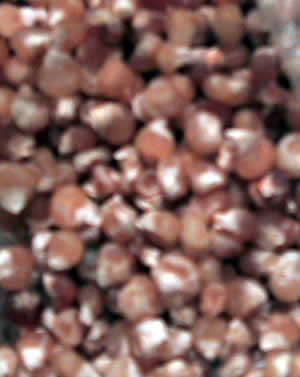
There are few things as simple and tasty as a pot of fresh cooked chicos. All that is required is water, chicos, pressure and time (sort of like the creation of igneous rocks, minus the chicos). First, you will need the following:
- 1 c of chicos
- 5 c of water
- salt to taste
- pressure cooker or crock pot
Step One: To clean the chicos, take the chicos out of the bag and spread them on a table. Pick out the burnt chicos. Place chicos in a small bowl,and slowly pour them into another bowl while blowing on them. This process removes any excess chaff on the kernels that remains. Rinse chicos in a colander or sieve.
Step Two: Place chicos and water in a crock pot or pressure cooker. Understanding the size of your cooker may vary, you can add 4 c of water instead of 5 c (I just like a lot of chico juice). If cooking in a crock pot, cook on low overnight and immediately turn off in the morning (about 8 hours later). If cooking in a pressure cooker, cooking time will be 50 minutes after the pot starts to "chiar" or hiss. remove from the heat and cool. Serve in bowls with salt to taste, or add red chile for good measure.
Chicos are traditionally served in a fresh pot of beans or with a meat of some kind. You can use beef, chicken, or whatever game bird or other meat you like. My next post contains a recipe for garlic-cumin pesto quails over chicos in red chile. My only caution is that the quails must be cooked right before serving on order to keep them tender and juicy, otherwise they dry out in the oven and turn that horrid grey color that many game birds turn when overcooked. EEK! For now, enjoy the simplicity of cooked chicos with salt and perhaps a bit of chile.
Labels: chili, corn, green chile, New Mexico, red chile, soup, traditional
Making Chicos Part Dos
November 07, 2006
 As promised, here is Part Dos of the Chicos post. The photo illustrations take the chico making process described in last week's post through to the end. We left off last when Faustina placed the last of her corn in the horno for roasting and mudded up the doors. The picture here is of her and her comadre washing their hands of the mud used to seal the doors closed for the night. The horno door, if you notice, is being chipped away here the next morning. The door had mud bricks on the inside of the oven, and a layer of adobe on the outside.
After breaking down the doors which were extremely hot from the overnight fire, Faustina reach into the oven with a pitchfork and her bare hands to remove the husks from the dying the embers. She placed the corn in a wheelbarrow and moved them to the back of a pick-up truck where myself, Faustina's comadre, and her brother stood with small paring knives.

At the truck bed, each of us took the corn husks, pulled them back, stripping the excess layers of silk and husk. We cut off the bottom stem of the corn to shorten it for drying. Faustina gathered each ear of corn we cleaned and she braided the thinned husks together to form a ristra. A ristra is made with corn or chiles by stringing the chiles or corn to dry outside in the sun. Faustina quickly braided about 12 ears of corn together to be strung up on her drying rack pictured here.
 Chicos need to be dried in the sunshine for several days until the kernels turn hard and wither into a dark brown. The chicos are then taken off the drying rack and rubbed together to remove the dried kernels. At this point, they can be stored in plastic bags or containers for storage year-round until they are cooked.
Faustina sent me the product of our labor not to long ago and I made quite a delicious chico soup. I promise to post that recipe for your enjoyment as well. Again, I'd like to acknowledge Faustina's kindness and generosity for taking the time to expose me to such an ancient art of food preparation.
Labels: corn, New Mexico, traditional
Making Chicos (that's roasted dry corn, not little boys!)
November 02, 2006

It is Dia de los Muertos (Day of the Dead) and it is time to feed your dead relatives and visit them at the cemetery. Traditionally, people leave candies and food by a loved one's graveside to celebrate and remember them. On this day, I am going to remember my dead with a post about chicos, and follow-up with a chico recipe.
Do you know what a chicos are? Well, if not, you'd have to ask someone in Southern Colorado or Northern New Mexico because not many others could tell you off the top of their head. As half of each, I can tell you with confidence that I know what chicos are: a roasted and dried ear of corn, the kernels removed and stored until cooking time. To tell you the story of how to prepare chicos however, I will employ many pictures from a recent visit I made with an elder relative who lives in my parent's "town" (if you can call it a town). Her name is Faustina and she is as old as her house (about 78), and she let me join her, her brother, and sister-in-law in the making of the chicos. What I share here are merely the impressions of that two day visit and by no means can capture the immense knowledge Faustina has of traditional food preparation techniques. All that I share is what Faustina was generous enough to teach me and I hope that these photographs will help preserve the traditions she has maintained for all of her life.
This post will be split into two to accommodate the explanations of the processes of preparation and actual recipes for cooking chicos. Additionally, I hope a two-part series will make reading the post easier.
To begin, I should give you some background about chicos and their origin. When I first moved to New Mexico, I was surprised to find chicos at the local Smiths grocery store in bulk. As a child, I remember having to track someone down on the side of the road selling them, or go to neighbors who toiled away to make any that year and buy them. The cost is usually around seven to ten dollars per pound because of the intense preparation required to make them. It was in New Mexico that I also learned that several Native American Pueblos had a delicious chico soup of some kind or another very similar to the type I grew up with as a Mexican-American. This is no coincidence however, because Pueblo peoples also introduced desert farm techniques to even make corn patches a possibility in the harsh climates of Northern New Mexico and Southern Colorado.
According to a student paper published on-line at New Mexico State University in Las Cruces: "Chicos are corn in the soft dough stage that has been steamed in the husk and dried. Traditionally, a pit was dug in the ground and the soil heated by burning wood in it for 1 to 2 days. The fire is removed and green ears in the husks are then placed in the pit and covered with soil. The partially roasted ears are removed, the husks stripped back, and the ears tied together in pairs and hung out to dry. The kernels were roasted to kill the grains, and to help them dry faster to preserve their food value. Chicos are generally cooked with chile and green onions, or in stews."
Apparently, chicos are also highly thought of in the slow food community who had this to say about chicos: "Chicos . . . . are small and wrinkled in appearance, and if the corn was roasted before drying, it can be very dark as well. When they are cooked . . . they swell up to their former size and taste like freshly smoked corn. . . . Chicos are made in two different ways. In the first method field corn is picked, shucked, then tied into ristras (strings) and hung to dry or alternatively, dried on screens. Once dehydrated, it is rubbed off the cob, and cooked until the kernels become clear, giving the corn a sweet, fresh taste. In the second method, white or yellow field corn is picked but not shucked, then put into a horno (adobe oven) to roast overnight. It is then tied into ristras and hung in the air to dry. Once the kernels are completely dried out, they are rubbed off the cobs and stored until ready to use. The kernels are dark from being roasted, and the roasting enhances their taste, adding a smoky flavor. Chicos are traditionally made by the American Indian nations of the southwest US as well as by the Hispanic culture that settled in the region hundreds of years ago."
Fau
 stina follows the method of cooking chicos that requires an initial roasting, then shucking and drying of the corn. In Mexico, it is much more common to simply dry the corn in piles rather than roasting before drying. To facilitate the roasting process, Faustina does not use a pit, but rather a traditional adobe horno (outdoor oven) that she and her brother constructed that she uses to bake breads and roast her corn (pictured on the left). Hornos have a solid adobe or poured concrete base, and a dome of adobe bricks that are covered with a layer of mud. The oven also has a small hole in the top for smoke, and a door in the front that can be blocked with more bricks for cooking, or simply a sheet of metal. To see the steps of construction, check out this link on New Mexico Culture Net.

After Faustina's sweet corn was ready to be picked, she lit a fire in the hornos and stoked them all night long until the morning. When the embers were still red, she placed her ears of corn inside, poured in a bucket of water, and sealed the horno door up with adobe bricks and mud. The mud was mixed on-site by her brother (pictured far left). The mud was used to fill in any cracks in the adobe ovens so that no heat escaped (pictured in center-left). The ears were left overnight in the oven to smoke and roast.

The process of preparing the ovens and placing the corn inside to roast was not simple. Faustina, in addition to roasting and drying her own corn, also grows her own corn. She hand picked the corn along with her brother and sister-in-law, and then prepared the ovens. She uses a sweet white corn she's grown for many years. When buying from the store, it is common for people to use a sugar queen variety of corn to make chicos.
For the next "Making Chicos" installment, I will present the story of removing the corn from the ovens, braiding, and drying it. I will also be posting a recipe later on that I am sure will inspire many of you to hunt down a roadside stand in New Mexico that sells chicos. If you can't make it there however, try the Albuquerque Tortilla Company on-line store.
Labels: corn, New Mexico, traditional
Simple Corn Chowder
July 20, 2006

I often go to my local bookstore and sit in the cooking section, browsing for cookbooks that I covet for my shelf of cooking wonders. I usually attend these leisurely reading sessions with pen and paper so I can jot down the ingredients to recipes that my catch my eye, or multiple recipes for the same dish so I can compare the ingredients. Recently, thumbing through the pages of the Barefoot Contessa's many cookbooks, I found a very simple recipe for corn chowder. I insisted on modifying her recipe, however, because she always adds way too much fat (butter, bacon grease, and cream) to her recipes and I just think that grease swimming at the top of your soup bowl will only bring you pesadilla and indigestion throughout your sleepless belly-aching night. I have modified what was obviously a recipe to feed a football team, and I have embellished the recipe with some of my own typical recipe touches (read garlic and fresh herbs here). Feel free to alter the recipe with the "optional" ingredients listed here, or not at all. This recipe is not gluten free, nor is it lactose free, so if you are either/or, adjust with corn starch and try a plain soy milk.
You will need:
- 3 tbsp of butter
- 2 tbsp of olive oil
- 1 yellow onion, cut in half, then sliced
- 2 cloves of garlic, minced
- 1/4 c flour
- 5 c of vegetable or chicken stock
- 6 small boiling potatoes (I used golden potatoes)
- 10 ears of fresh corn, kernals off the cob, or use 1 pkg of frozen sweet summer corn
- 1/2 c of cream or half-and-half
- 2 sprigs or 1 tsp of thyme
- optional: in lieu of olive oil, cook 6 slices of bacon or pancetta until slighlty crispy. Chop up bacon and set aside, and use 3 tbsp of reserve bacon fat for soup (I know some of you are just wincing in pain and disgust, but hey, if you see what the Barefoot Contessa actually looks like, and you still want to follow her instructions on using ALL the reserve bacon fat, more power to you)
- optional: 1 tsp of turmeric
Step One: In a large stock pot, saute the onions and garlic in the fat (whatever fat you choose above) over medium-high heat. After 7 minutes, add the flour, pepper to taste, and optional turmeric. Stir this around so the flour becomes totally incorporated into the mix and thickens into a roux, (like a paste). This takes about 5-8 minutes, depending on how often you are stirring. Add the stock and quartered boiling potatoes. Let this boil for 15 minutes or until the potatoes are soft.
Step Two: Meanwhile, in a separate small pot, bring 4 c of water to a boil, then toss in the corn to blanche for 4 minutes. Drain immediately and add 1 c of this cooked corn to the stock pot with the potatoes and onions. Reserve the rest of the corn. Take the contents of the large stock pot and puree them in a blender. You may have to divide this up into two "trips" because the blender could overflow otherwise. Return the puree into the large stock pot and add reserved corn, and bacon if any. Pour in the cream and cook for another 5 minutes.
Serve soup with fresh thyme. Barefoot Contessa served her soup with large handfuls of sharp cheddar cheese, but I find this combination to be vile and only suggest it if you'd like to further clog your arteries. The soup as is (minus the bacon and cheese) is like velvet with the bits of corn contributing to the overall look of the soup. I left a couple of potatoes to the side and chopped them up for more texture. Feel free to experiment with this recipe, it is very basic and yearns for your creativity.
Summer Corn Gordita
May 29, 2006

Summer corn is a sweet sugary luxury coming to a grocery store near you. I found this recipe in an old Joy of Cooking for Vegetarians cookbook and it did not disappoint. I give the recipe 5 stars and highly recommend it for BBQ's, kids, and as a snack or appetizer. The key to this recipe is to use FRESH summer corn off the cob, you MAY NOT use canned or frozen corn here, and winter corn varieties will taste starchy and unsweet.
You will need:
- 5 fresh ears of sweet summer corn;
- 2 eggs with yolks and whites separated;
- salt & pepper to taste;
- 1 tbsp sugar;
- 2 tbsp flour;
- 2 tbsp butter or olive oil to cook.
Step one: Take those ears and cut off the kernels of corn using a knife. Chop up the pile of corn with a knife until some of the jucies are released.
Step Two: Combine the corn, flour, sugar, salt & pepper in a bowl until well mixed. Add the 2 egg yolks slightly beaten into the mixture. Set aside.
Step Three: In a mixing bowl, whip the egg whites until they are very stiff and bright white. This takes about 4-6 minutes to do with an electric mixer. Fold in the corn mixture.
Step Four: Dollop the batter into a hot skillet with 2 tbsp of olive oil or butter on medium-high heat. Reduce heat after 1 minute to medium and finish cooking until light brown, about 2 minutes. Flip once and finish cooking off other side for another 2 minutes or until golden. Serve hot with a side of red chile and beans for a yummy meal or snack.
The corn pancake or gordita-like patty goes great with a queso fresco too. I really like the crunchy texture of the corn kernels and the light unobtrusive flavor of the batter that holds these golden kernels of fresh corn together.

